“The Vivid Hues from the Deeper Depths of Dreams” continues the theme of Oneiric Artscape, Phantasmagoric Visions, marking the third public presentation of the Dream-making Laboratory’s outcomes. This edition likewise highlights the intersection and integration of literature and art. A diverse range of media is showcased in this presentation, encompassing watercolor, oil painting, fashion design and digital illustration. Just as the previous two editions, this one was also curated, organized and presented by Dr. Huang Xiao (a Professor, Curator and Poet working at International College of The Arts, Krirk University), the artists participated are a group of young postgraduate students studying arts in Krirk University.
The Vivid Hues from the Deeper Depths of Dreams
Curator: Dr. Huang Xiao
Photographer: Dr. Huang Xiao Poems: Dr. Huang Xiao
Artists: Lou Yang, Qi Yutong, Wang Huihan, Yang Zeyi, Ye Luoyuan, Liu Fengyi, Hu Haiyun Exhibition Locations: Henry’s Cottage Gallery; House of Captain; Online.
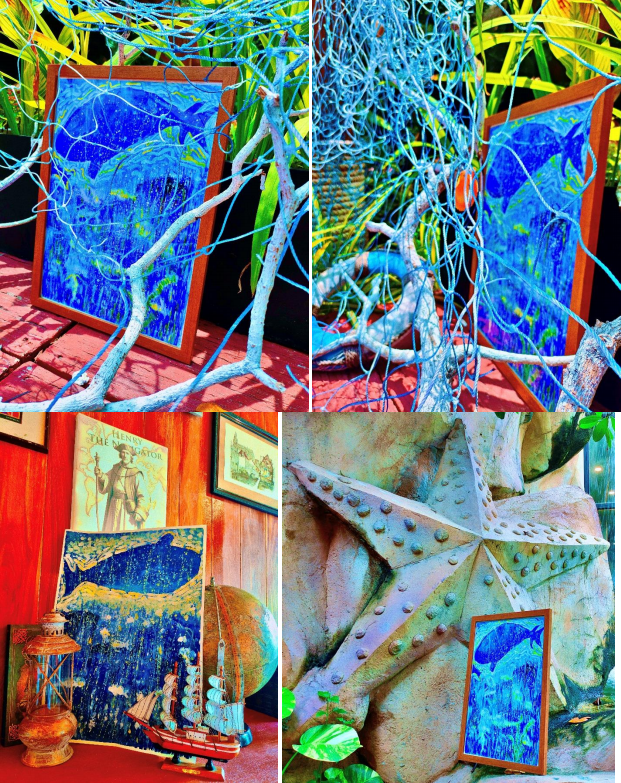
Exhibition/Presentation 1. The Whale that Fell into the Heart of the Ocean (Watercolor Paintings by Mr. Lou Yang, Photos & Poems by Dr. Huang Xiao)
“In a haze of sleep,I found myself drifting into the forgotten ruins of an ancient structure,hidden in a remote corner of the deep sea. Looking up, I saw an enormous whale gliding above the architecture, circling silently.
The paintings seek to capture the mysterious vitality of the deep sea at night—aworld both tranquil and vast, yet brimming with the unknowable. White and yellow lines twist and weave like ethereal spirits—serpentine or intersecting—forming cloud-like shapes that blur the line between the real and the imagined, lending the scene a dreamlike quality.
White specks shimmer across the canvas, evoking distant stars, drifting snow, or falling rain. These elements breathe life and motion into the stillness. Through techniques of dripping, smudging, and blending, the artist allows the pigments to flow freely, generating a spontaneous yet powerful visual resonance—like the fragmented, awe-striking images of a dream.
Overall, the work seeks to break free from the orderliness of reality, revealing the surreal poetry of the ocean’s depths. It calls forth the viewer’s deep-seated longing for the unknown, inviting them to wander through the boundless mystery of a world beneath the waves.”
—— Lou Yang
Selected Artworks:
Poems Inspired by “The Whale that Fell into the Heart of the Ocean”
Dr. Huang Xiao
Above the Whale, Beneath the Dream
I sank into the ocean’s dream,
like a fallen star slipping from its altar, awakening within the ribs of ruin.
Above me, the ancient whale drifts— not a creature,
but the echo of an era.
Mist coils like sigils through the water, light forgetshow to move in lines.
White specks float— are they stars? snow?
or the name you never spoke aloud?
Each yellow curve whispers: “This is not reality.”
This is the lower layer of dreams, a glimmer before memory drowns.
Light in the Ruins
The deep-sea night is an inverted sky.
A whale glides past broken eaves, its eyes carrying the language
often thousand years ago.
Smudged blues, dripping blacks— as though the gods abandoned
their last unfinished manuscript. And you, with your fingers,
weave the fragments back into form.
The white lines sketch more than cloud— they trace the breath of forgotten gods,
pointing toward a place no compass ever knew.
We are not divers.
We are wanderers of dreams,
gathering the final fleck of light before we forget how to see.
Upon the Canvas You Never Named
Your brush is the whale’stail, sweeping across ruins,
stirring the silence of the deep.
And the soul—pulled by threads of white— floats between reason and reverie.
This is not a reflection of reality, but its true face.
Snow, rain, stars— they converge here,
as in the first dream you ever had.
You never painted an answer. You painted a question:
Why does the whale linger above the ancient hall
and never depart?
Exhibition/Presentation 2. Cosmic Amusement Park (Digital Illustrations by Ms. Qi Yutong, Poems by Dr. Huang Xiao)
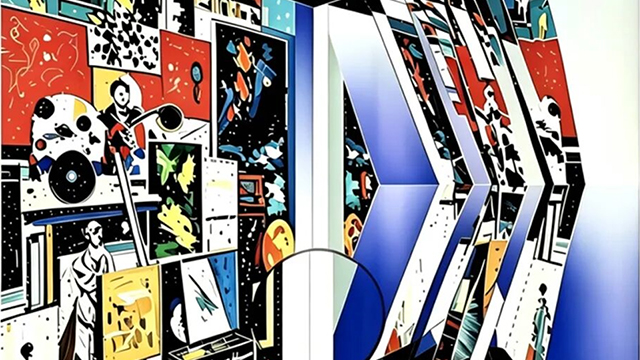
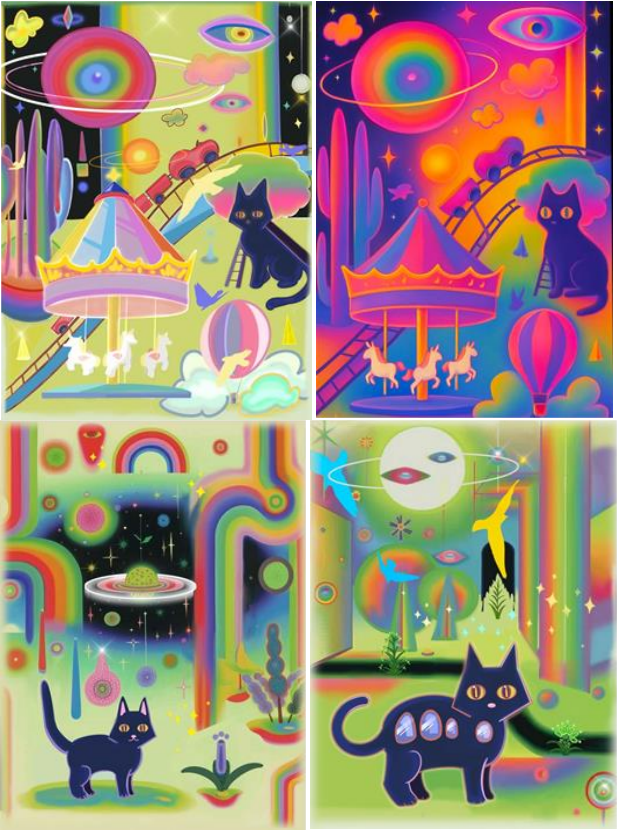
The creative inspiration for “ Cosmic Amusement Park” originated from a hazy dream interwoven with innocence and fantasy. In that boundless dreamscape, the familiar amusement park walls were replaced by the vast galaxy; the childhood roller coaster queues transformed into interplanetary tracks. This wondrous connection across time and space became the core starting point of my creation.
Recalling the brilliance of the carousel, the thrill of the roller coaster, and the romance of the Ferris wheel, these tangible symbols of carefree joy became the “anchor points” of inspiration that tethered my childhood dreams to a cosmic dimension. At the sametime,I was deeply influenced by surrealist art—such as Dalí’s absurd compositions and Miró’s symbolic expressions—longing to break the shackles of reality and allow childlike elements to grow freely in apsychedelic universe.
The inclusion of the “black cat” motif is a thoughtful choice: it is both a symbol of mystery and a childhood “companion” exploring the world, linking the viewer’s emotional resonance through the fantastical scenes. Elements like the “eye planet” and “rainbow architecture” stem from my curiosity about “another possibility of the world”—what kind of landscape would emerge if childhood fantasies defied the laws of physics?
In terms of color expression,I adopted highly saturated, psychedelic tones (such as neon rainbows and glowing planets) to create animmersive feeling of a “nighttime amusement park + interstellar fantasy”, emphasizing a surreal and whimsical atmosphere. At the sametime,I used low-saturation tones in the style of Giorgio Morandi to restore the warm texture of childhood memories through soft colors, forming a stylistic contrast yet maintaining thematic coherence across the series.
This series of illustrations takes “childlike fun” as its root, deeply embedded in vivid memories of childhood amusement parks; and takes “surrealism” as its wings, soaring freely in the dimension of the cosmos. Through layers of symbolism, color, and narrative,I have constructed a world that is both familiar and strange—a fantastical extension of childhood dreams, and a romantic breakthrough into pure imagination for the adult soul.
—— Qi Yutong
Selected Artworks:

Dr. Huang Xiao n
Only dreams spinning in place amid starlight.
Swirling around spacetime—never fading.
I purchase dizziness at 300,000 kilometers per second.
The entire solar system turns clockwise with sweetness.
Each thorn a receiving antenna.
Uttering whispers encrypted in ice crystals and flame,
To decipher the cosmic code with the warmth of a palm.
Giving lift to dreams that have no wings.
Would they tell tales of cats that fly?”
All winds begin to drift toward childhood.
Building steps toward Orion.
The spire hovers—an unfinished “goodnight”.
Waiting for vines to climb toward the moon.
But holds a castle, luminous.
Guiding who shall remember, who shall lose their way.
As sudden delight in a child’s eyes.
A night casino silently operates.
Hounds tally light-years with their tails.
Betting on the next collapse of luck.
Time freezes inside a ring of ice crystals.
assembling rainbow bridges in the stratosphere.
When they transform into desk stationery,
a child is stuffing starlight into a pencil case.
Who says metal won’t reshape for dreams?
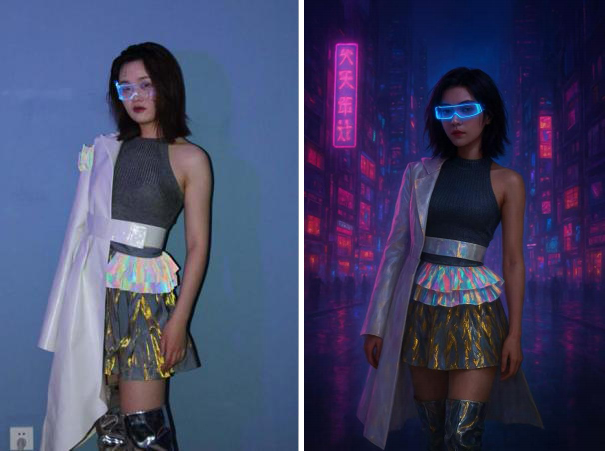


Poems Inspired by “Wanderer”
Dr. Huang Xiao
Of Raiment and Circuitry
Rose and indigo cleave the arteries of rain-soaked dusk;
neon wounds bloom soft upon your skin of tempered steel.
You are draped in a halo spun from murmured auguries,
while torrents of data
rise and fold within your robe’s cascading lines.
In the vitreous depths of your synthetic gaze,
a thousand echoes of myself
pass through cataracts
of spectral advertisement.
Within a sanctum wrought of pixel-light and code,
I stoop to gather
the feathered relics
your metal wings have left behind.
Silken Necrology
In the marketplace steeped
with hues of ashen green and blood-dark red,
lanterns hover—suspended vermilion moles
on the face of dusk.
Archways inscribe soul-summoning charms
in neon-tinted seal script,
while stone effigies in shadow
murmur forgotten dynastic names.
When cybernetic sleeves brush past
the bronze snarl of a taotie,
a hundred thousand bytes
plunge into the River of Forgetting.
At the fiber-optic-wrapped Bridge of No Return,
we trade magnetic slips—
charm-shaped codes for reincarnation.
Hymn of the Mechanical Gothic
Moonlight, dyed a bluish-green elixir,
drips through the ribs of cathedral vaults.
Orange neon signs, like rebellious stigmata,
inscribe inverted gospels upon the spires.
Then suddenly,
the circuitry of your garment begins to sing—startling bronze crows into flight,
gear-clutched in beak, ascending skyward.
In this eternal lattice of contradiction,
we are all apostles,
gilded in chrome.
On the Fabric of Spacetime
The forest compiles encrypted tongues
in the weaving of its twisted vines.
Clocks melt softly
at the lapels of tailored suits.
A mechanical hare leaps over data-moss,
while streetlamps quietly bake
paradoxes into warmth.
When all dimensions lose their coordinates,
you still preserve
the narrative seam of attire—
stitching star maps
into the folds of reality,
marking the path home
with phosphorescent thread.
The Grammar of Garment
What is stitched is not merely fabric and thread—
but the fractures of time,
the reconstruction of style.
The fall of a single silk strand
hints at a turning point in the tale;
the path of a zipper
pulls open the next dimension.
With metal, I sew in unspoken memory;
with collage,
I allude to time ruptured and reassembled.
Cloth sways in the wind as if speaking—
a language, an image,
a mutation of the written text.
Between body and setting,
garment becomes a bridge,
telling the myth
that has yet to be completed.
Ruins of the Future
This is no prophecy,
but archaeology—
an excavation of meaning
from what has not yet come to pass.
Before the city fell to ruin,
we paraded in ceremonial dress;
only when the clocks began to melt
did we begin to awaken.
Architecture twists within time,
while garments are reborn
in shifting contexts.
We wear the clothing of the future,
yet descend into the bedrock of memory.
You ask, What is the future?
It is the lamp left burning in the dark,
the garment in a dream—
never once removed.
Exhibition/Presentation 4. Nightmare – Hunger (Oil Paintings by Mr. Liu Fengyi, Photos &
Poems by Dr. Huang Xiao)
“In the struggle of weight loss—a confrontation with one’s own desires—the physical torment is captured by dreams woven from the subconscious. The central figure in the image is a gaunt, emaciated skeleton, yet within its hollow frame remains flesh and organs. It is not the cold symbol of death as found in traditional art, but rather a visual embodiment of the dieter’s fear of hunger.
Each protruding rib resembles a thorn, piercing into the psyche of the one who fasts, triggering an intense anxiety toward starvation. The figure speaks without words, revealing the silent agony of a body caught in the battle between reason and appetite—an inner war waged in the shadows of hunger.
This skeleton represents the fragile side of the dieter’s inner world, a haunting tremor of the soul under the crushing weight of deprivation. It is the embodiment of despair when the mind begins to waver, engulfed by fear and the unraveling of self.
The skeleton’s withered yet grotesquely elongated hands stretch outward like a ghost breaking free from its shackles, reaching toward the city. In my paintings, the city consistently symbolizes abundance and prosperity. Here, it represents the deep, burning desire within the dieter’s psyche to alleviate hunger.
These outstretched hands are a manifestation of instinct—the dieter’s primal yearning for even a glimpse of relief from starvation’s grip. They embody the urgent, almost desperate longing for an escape from the abyss of deprivation.
The muted, somber tones cast a shadow like a curtain of hunger itself, suffocating and heavy, mirroring the weight of physical and emotional exhaustion. The chaotic brushstrokes reflect the violent inner turbulence of someone caught in the storm of hunger—expressing rage, resistance, and sorrow. Every mark records a moment of pain, every stroke a cry from within: a visceral documentation of suffering, and of desire that will not be silenced.”
—— Liu Fengyi
Selected Artworks

Poems Inspired by “Nightmare – Hunger”
Dr. Huang Xiao
Skeleton and the City
Every rib erected into bars
Imprisoning the stomach that still writhes
Yet hands break calcium chains
Reaching toward neon-drenched feasts
When the moon sours into a tarnished plate
The city bakes honey in shopwindows
All the canceled dinners
Raise riotous flags in our veins
Geometry of Hunger
On the seventh day hunger learned to bend
Piercing peritoneum in parabolic curves
Organs rearranged by subtraction
Like abandoned instruments holding form
While the city, this colossal sugar fortress
Feeds the night sky with light pollution
We negotiate across skin
Polishing hope’s lever with bile
Metabolic Ballad
When pubic bones chime the last shift
Pelvis begins harboring stray starlight
Adrenals secrete iron dew
Watering the thinning clock
Supermarket shelves photosynthesize
Sated spirits copulate under sale signs
Only this honest skeleton keeps
Recording each calorie’s last words
Paradox of Satiation
They wrap hunger in brocade
Nailing appetite to the wedding dress waist
When champagne bubbles burst at the banquet
My spine sprouts on the menu
Amid the abundance built by desserts
Calcium is the first to break vows
If plumpness is original sin
Strip me of my last gram of restraint
Exhibition/Presentation 5. Brainstorming Voyage: Exploring the Uncharted Mind (Digital Illustrations by Ms. Hu Haiyun, Poems by Dr. Huang Xiao)
A little girl leaned by the window, the teacher’s voice echoing in her ears as she drifted off. Staring at the second hand on the clock, she thought, “If only we could go straight home after brushing my hair and eating fruit this afternoon.” As she kept thinking, the forest and mushrooms in the picture book beside her seemed to come alive and appear before her eyes. She blinked, gazing in wonder at the world in front of her—time seemed to stop in that moment.
At some point, a cage, a plate of fruit, and a black-screened phone appeared around her. She was thrilled and tried to pick up the phone, but she couldn’t move. Just then, a monster suddenly crawled out of the phone. She wanted to run but couldn’t, watching helplessly as the monster reached its claws out toward her...
—— Hu Haiyun
Selected Artworks


Poems Inspired by “Brainstorming Voyage: Exploring the Uncharted Mind”
Dr. Huang Xiao
Mirage of the School Bell
Chalk dust hovers in the sunlight,
The second hand catches in the arc of a butterfly’s wing.
The borders of the picture-book begin to dissolve,
As mushroom clusters spread into forests over arithmetic pages.
Eraser shavings turn into fireflies,
The blackboard eraser sweeps across the moon’s craters.
When the school bell solidifies among coral reefs,
Whose childhood is now overflowing with chimes from the mirror’s surface?
The Monster in the Phone
The phone is dark as a well,
She sees herself reflected deep within,A hand reaches out
as if grasping an unfinished prayer.
The monster wears a cloak woven of data,
its eyes are spinning glitches.
Slowly, it crawls from the screen
like a slip from the edge of a nightmare.
She wants to scream, but only blinks;
she wants to flee, yet even her shadow is trapped in place.
The world stands still, save for the fear—
like a sleeping bird suddenly startled awake.
The Moon of Marbles
The moon is not stone, but a marble,
a glass sphere of shimmering hues,
rolling on the universe’s carpet.
With every turn, it shatters into fantasies.
A planet has grown wings,
hovering among the clouds like a bird in flight.
Clouds melt slowly in the sunlight,
dripping as pigments on a child’s drawing.
Someone settles into a wine glass,
brewing dreams from crimson wine.
In the dream, a snail crawls out from the mirror,
trailing a string of reflections, sliding toward an unknown world.
Paradox within the Fruit Stone
The fruit knife slices through the afternoon’s cross-section,
inside the pit hides a shrunken night.
The cage bars contract with each breath,
every exit begins to bend into question marks.
The banyan tree spreads its rainbow ribs,
the clock face opens its hundred-eyed gaze.
Before the clouds drip onto the windowsill,
a planet has slipped the ropes of gravity.
Chocolate beans on the lunar surface
roll out trails like comet tails.
When wings overgrow the entire sky,
what imprisons us is precisely the weightless fantasy.
Coordinates of the Eternal Instant
Trapped in a moment thick as honey,
a scream sprouts into vines within the throat.
Pine forests devour the unripe sunset,
a clawed hand pierces the digital screen’s ripple,
seizing a distant shore not yet set sail.
Yet fairy tales keep growing on the reverse side,
like a snail’s silver trail rewriting reality’s laws.
When all grotesques take their final bow,
fantasy becomes the only true free fall.